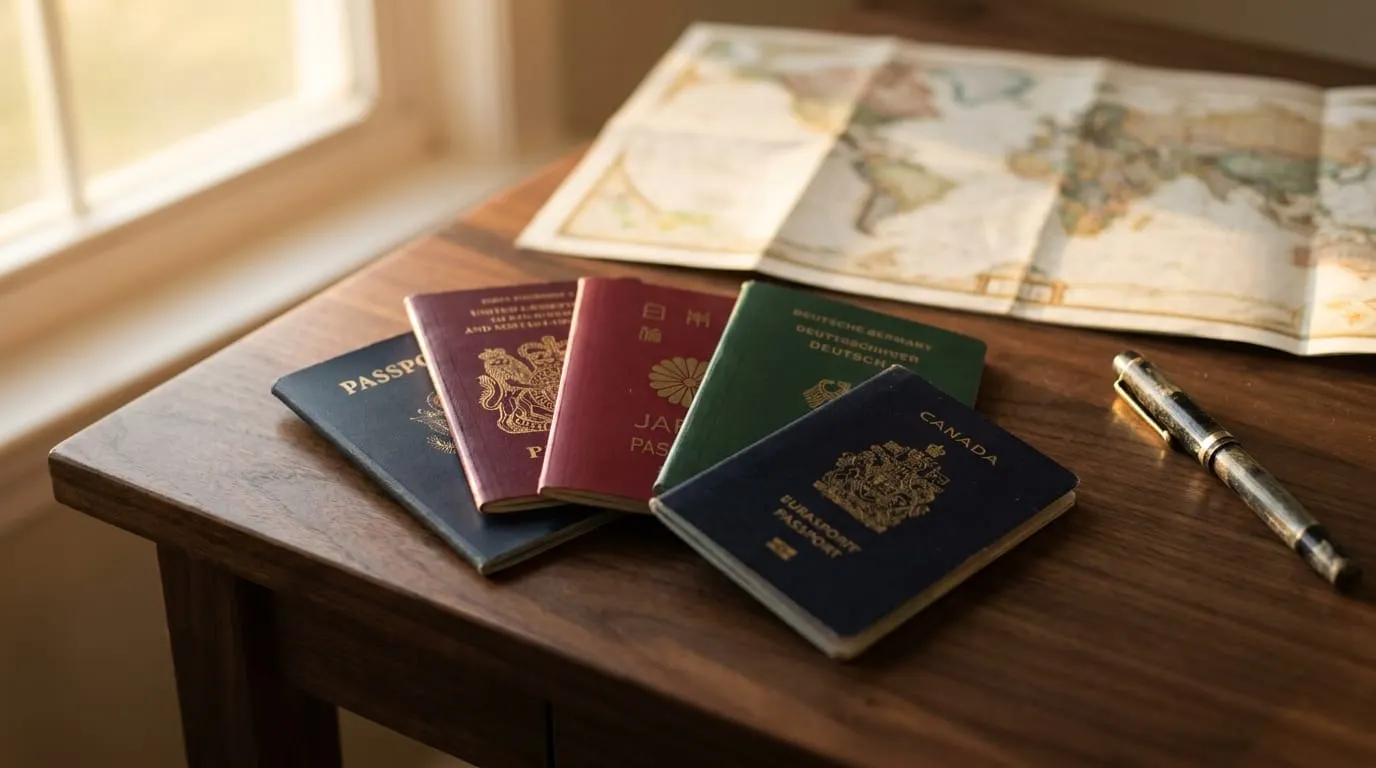

A second passport is the travel document of a second citizenship, not a golden visa or residence permit. You acquire it four ways: by descent, by naturalisation through residence, by marriage, or by citizenship by investment. Costs in 2026 range from near-zero for descent to USD 200,000 or more for Caribbean investment.
Last updated 14 June 2026. Second-passport rules move fast, so the figures and visa policies below carry dates; confirm each against the issuing authority before you commit.
For the wider legal picture on holding two nationalities at once, see our pillar guide on dual citizenship explained.
Key Takeaways
- A second passport requires a second citizenship; a "golden visa" grants residency but never a passport (Global Citizen Solutions, 2026).
- In March 2024 four of the five Caribbean programmes agreed a harmonised minimum of USD 200,000, but only Dominica now sits at that floor; others run USD 230,000 to USD 250,000 (IMI Daily, 2024).
- On 29 April 2025 the Court of Justice of the EU ruled in Commission v Malta (Case C-181/23) that Malta's investor-citizenship scheme breached EU law, ending the last citizenship-by-investment route to an EU passport (CJEU, 2025).
- Singapore tops the Henley Passport Index 2026 with visa-free access to 192 destinations; the UK ranks 6th and the US 10th at about 179 (Henley & Partners, 2026).
- A second passport does not remove a US tax obligation; the United States taxes citizens on worldwide income wherever they live, and only renunciation ends it (IRS, 2026).
- Ireland revokes visa-free entry for St Kitts and St Lucia passport holders from 15 June 2026, one of several 2026 tightenings around investment citizenship (IMI Daily, 2026).
What exactly is a second passport, and what isn't it?
A second passport is simply the travel document of a second citizenship, and that distinction is where most people go wrong. Residency programmes, the so-called "golden visas", give you the right to live somewhere but no passport at all (Global Citizen Solutions, 2026). You only hold a passport once a state grants you its nationality. So the real question is never "which passport?" but "which citizenship?".
Think of it as three nested layers. A visa lets you visit. Residency lets you live somewhere, often for a fixed renewable term. Citizenship makes you a national of that country, with the passport, the vote and, usually, the right to pass nationality to your children. Only the third layer produces a second passport. A UAE 10-year Golden Visa, for instance, is residency by investment; it never becomes an Emirati passport.
Passport versus citizenship versus residency
Here is the line that matters for budgeting and for promises. A Caribbean investment programme grants citizenship, so it produces a passport. A Portuguese or Greek golden visa grants residency, so it does not, at least not until years of residence and naturalisation follow. Conflating the two is the single most expensive mistake in this market, and intermediaries sometimes blur it on purpose.
Is it legal, and what about dual citizenship?
Holding two passports is lawful in much of the world, but not everywhere. Many countries, including the UK, Ireland, Italy, the US and Canada, fully accept dual citizenship. Some force a choice, and a few, such as China, strip your original nationality the moment you naturalise elsewhere. Always check both ends: the country granting the new passport and the one you already hold. We cover the full map in our guide to dual citizenship.
Citation capsule: A second passport is the travel document of a second citizenship, not a residence permit; golden-visa programmes grant the right to live in a country but never a passport, which is issued only once a state confers its nationality (Global Citizen Solutions, 2026). Whether you may hold two depends on the laws of both countries.
What are the four routes to a second passport?
There are four legitimate routes to a second citizenship: descent, naturalisation, marriage and citizenship by investment, and they differ enormously in cost and time. Descent can cost a few hundred dollars in government fees but take two to five years; investment can cost USD 130,000 to USD 250,000 but conclude in roughly five to nine months (Global Citizen Solutions, 2026). Most people qualify for more routes than they realise.
Citizenship by descent
Descent is the cheapest route by a wide margin, and the most overlooked. If a parent, grandparent or, in some countries, great-grandparent held a nationality, you may claim it. Government fees typically run USD 200 to USD 1,000, with another USD 2,000 to USD 5,000 in legal and genealogy help if you need it. The catch is paperwork and patience: Italian claims can take five to seven years. Rules also tighten. Italy restricted its jure sanguinis route to a parent or grandparent born in Italy in May 2025, upheld by the Constitutional Court in March 2026 (CIC News, 2026). Canada, by contrast, expanded descent rights in December 2025. Start with our explainer on citizenship by descent.
Naturalisation by residence
Naturalisation is the slow, ordinary path: live somewhere legally for long enough and apply. Residence requirements commonly sit at five to ten years or more, and you usually need physical presence, language tests and a clean record. It costs little beyond the cost of living there, but it demands real time on the ground, which suits people relocating anyway rather than those wanting a fast Plan B.
Marriage
Marriage to a citizen can shorten the naturalisation clock, often to one to five years of residence, with low administrative cost. It is not instant and not automatic; states scrutinise these applications closely for genuineness, and timelines vary widely by country. It works best as an accelerator of naturalisation, not as a standalone shortcut.
Citizenship by investment
Citizenship by investment, or CBI, is the fast, expensive route: you make a qualifying contribution or property purchase and receive citizenship in months rather than years. The Caribbean programmes complete in roughly five to nine months, with St Kitts and Nevis often fastest at around five (Global Citizen Solutions, 2026). It is the only route where money substitutes for time or ancestry, which is exactly why it draws the most regulatory scrutiny. Our full guide is at the citizenship by investment guide.
Citation capsule: The four routes to a second passport are descent, naturalisation, marriage and citizenship by investment; descent costs only a few hundred dollars in fees but takes two to five years, while investment costs USD 130,000 to USD 250,000 and completes in roughly five to nine months (Global Citizen Solutions, 2026). Marriage and naturalisation fall in between.
What does a second passport cost in 2026?
Costs span from a few hundred dollars by descent to USD 250,000 by Caribbean investment, and the investment figures are widely misquoted. In March 2024 four of the five Caribbean programmes agreed a harmonised minimum of USD 200,000, but actual country minimums now vary, with only Dominica still at that floor (IMI Daily, 2024). Treat any single headline price with suspicion.
The Caribbean floor versus the real prices
The USD 200,000 figure is a floor agreed between governments, not the price most countries charge. On the donation route, single applicant, excluding government, due-diligence and processing fees, the 2026 minimums run as follows: Dominica USD 200,000 at the floor; Antigua and Barbuda about USD 230,000; Grenada about USD 235,000; St Lucia about USD 240,000; and St Kitts and Nevis USD 250,000 (Global Citizen Solutions, 2026). Mark the non-Dominica figures "approximate, confirm against the country's CIU before you budget." Real-estate routes cost more, and family pricing differs. Our country-by-country breakdown sits at Caribbean citizenship by investment.
Malta and the closed EU route
The one EU passport you could once buy is gone. On 29 April 2025 the Court of Justice of the EU ruled in Commission v Malta (Case C-181/23) that Malta's investor-citizenship scheme breached EU law, ending the last citizenship-by-investment route to an EU passport (CJEU, 2025). Existing holders keep their status, but new investor applications are closed and Malta has moved to a merit-based framework. Before the ruling, the route cost EUR 600,000 over 36 months or EUR 750,000 over 12, plus property or donation. Treat Malta CBI as shut for 2026. The full history is in our note on Malta citizenship by investment.
Vanuatu and the cheaper options
Vanuatu is the lowest-cost CBI passport at about USD 130,000 for a single applicant, but it is also the least stable. The programme has faced repeated EU visa-free suspensions, which erodes the main reason people buy it. If mobility is your goal, a low headline price that loses visa-free access to the Schengen area is poor value. Price and stability move together here, so weigh both, not just the sticker.
Citation capsule: In March 2024 four of five Caribbean programmes agreed a USD 200,000 floor, yet only Dominica sits there in 2026; Antigua runs about USD 230,000, Grenada USD 235,000, St Lucia USD 240,000 and St Kitts USD 250,000, while Malta's EU route closed after the CJEU's 29 April 2025 ruling in Case C-181/23 (Global Citizen Solutions, 2026; CJEU, 2025).
How long does a second passport take to get?
Timelines range from about five months for Caribbean investment to a decade for naturalisation, and the route you pick is the biggest variable. Caribbean CBI completes in roughly five to nine months in 2026, with St Kitts often fastest at around five, while naturalisation by residence commonly takes five to ten years or more (Global Citizen Solutions, 2026). Speed and cost trade off almost perfectly.
Descent sits awkwardly in the middle: cheap but slow. Government processing of an ancestry claim runs two to five years, and Italian jure sanguinis files can take five to seven, partly because of consular backlogs and document legalisation. Marriage typically shortens naturalisation to one to five years of residence. So if you need a passport this year, investment is realistically the only route; if you have time and the right grandparent, descent is far cheaper.
One practical point from our own casework. The published timeline is rarely the real one. Due-diligence queries, missing civil records and apostille delays routinely add months, especially on descent claims where a single mistranslated birth certificate can stall a file for a year. Build slack into any plan that hinges on a hard deadline.
Citation capsule: Caribbean citizenship by investment completes in roughly five to nine months in 2026, with St Kitts and Nevis often the fastest at around five months, whereas naturalisation by residence commonly takes five to ten years or more and descent claims two to five years, or five to seven for Italy (Global Citizen Solutions, 2026).
What are the benefits of a second passport, and what aren't they?
The honest benefits are mobility, optionality and family security; the dishonest ones are guaranteed tax savings and fixed visa-free counts. Singapore tops the Henley Passport Index 2026 with visa-free access to 192 destinations, the UK ranks 6th and the US 10th at about 179 (Henley & Partners, 2026). Caribbean passports are useful but rank lower, and their mobility is shrinking in 2026.
Mobility is the headline benefit, but quote it carefully. Visa-free access changes constantly, so a static claim like "the Caribbean gets you 140-plus countries" is already wrong by the time you read it. Use a dated index instead. The durable benefits are less flashy: a genuine Plan B if your home situation deteriorates, the ability to include a spouse and children, and diversification of where your family can live, bank and do business.
What a second passport does not do is reduce taxes by itself. We return to that below, because it is the most over-sold promise in the whole market. A passport is a right to enter and remain; it is not a tax plan. For where the strongest passports actually sit, see our ranking of the most powerful passports.
Citation capsule: On the Henley Passport Index 2026, Singapore leads with visa-free or visa-on-arrival access to 192 destinations, the United Kingdom ranks 6th and the United States 10th at about 179; Caribbean investment passports rank lower and their mobility is under active pressure in 2026 (Henley & Partners, 2026).
What are the risks of a second passport in 2026?
The real risks are programme instability, dodgy intermediaries and the myth that a passport cuts your tax bill. In 2026 the regulatory squeeze is intense: Ireland revokes visa-free entry for St Kitts and St Lucia from 15 June 2026, and the US has floated visa bonds of USD 5,000 to USD 15,000 for some Caribbean nationals (IMI Daily, 2026). These are not edge cases; they are this quarter's headlines.
Programmes under pressure
2026 is a hard year for investment citizenship. Beyond the Ireland revocation effective 15 June 2026, the picture includes a US immigrant-visa freeze cited for all five CBI nations, St Kitts mandatory biometrics from 8 January 2026, the EU's ETIAS travel authorisation expected to become mandatory in late 2026, and a new regional regulator, ECCIRA, forming (IMI Daily, 2026). Each erodes the mobility that justifies the price. A passport bought for visa-free travel can quietly lose much of its value within a year, so buy for optionality and a second home base, not for a visa-free number that may not survive.
The tax reality
A second passport changes nothing about US tax, and this trips up Americans constantly. The United States taxes its citizens on worldwide income wherever they live; FBAR reporting applies once foreign accounts exceed USD 10,000 in aggregate, and FATCA above IRS thresholds (IRS, 2026). A second passport does not remove a US tax obligation; only renunciation does, and that can trigger an exit tax for covered expatriates, with administrative fees and a possible exit tax applying. Non-US nationals should still take personal tax advice, because tax residence, not citizenship, usually drives the bill.
Scams and due diligence
The market attracts bad actors. Use only licensed agents, verify every figure against the country's Citizenship by Investment Unit, and be wary of anyone promising guaranteed approval, secret discounts or a passport with "no questions asked". Citizenship obtained through fraud or misrepresentation can be revoked years later, which destroys the asset you paid for. Slow, documented and licensed beats fast and cheap every time.
Citation capsule: In 2026 investment-citizenship programmes face a regulatory squeeze: Ireland revokes visa-free entry for St Kitts and St Lucia from 15 June 2026, and the US has floated visa bonds of USD 5,000 to USD 15,000 (IMI Daily, 2026). A second passport does not remove a US tax obligation; only renunciation does, with a possible exit tax (IRS, 2026).
To map your own ancestry, residence history and goals to the right route, and to avoid the intermediaries this market is full of, you can speak to Ancova's citizenship team for an advisory view before you commit any money.
Frequently asked questions
What is the difference between a second passport and a golden visa?
A second passport is the travel document of a second citizenship; a golden visa is residency by investment and grants no passport (Global Citizen Solutions, 2026). A golden visa lets you live somewhere, often for a renewable term, but you only get a passport after naturalising or through a citizenship route. They are different products at different prices. See our dual citizenship guide.
What is the cheapest second passport in 2026?
By descent it can cost only a few hundred dollars in government fees if you have qualifying ancestry (Global Citizen Solutions, 2026). Among investment options, Vanuatu is cheapest at about USD 130,000 for a single applicant, but it is the least stable, with repeated EU visa-free suspensions. Caribbean donation routes start at USD 200,000 in Dominica.
Is the Malta citizenship-by-investment route still open in 2026?
No. On 29 April 2025 the Court of Justice of the EU ruled in Commission v Malta (Case C-181/23) that Malta's investor-citizenship scheme breached EU law, ending the last citizenship-by-investment route to an EU passport (CJEU, 2025). Existing holders keep their status. Malta now runs a merit-based naturalisation framework instead. See our Malta CBI note.
Will a second passport reduce my taxes if I am American?
No. The United States taxes its citizens on worldwide income wherever they live, and a second passport does not change that (IRS, 2026). Only renunciation ends a US tax obligation, and that can trigger an exit tax for covered expatriates, with administrative fees applying. Take personal tax advice before acting; tax residence usually matters more than citizenship.
Which second passport gives the most visa-free travel?
On the Henley Passport Index 2026, Singapore leads with visa-free access to 192 destinations, the UK ranks 6th and the US 10th at about 179 (Henley & Partners, 2026). Caribbean investment passports rank lower and their mobility is shrinking in 2026, so check current access before buying. See the most powerful passports.
Ready to work out which route fits your ancestry, residence and budget? You can talk to Ancova's citizenship team for an advisory, receipts-first view before you commit.
Sources
- Global Citizen Solutions, "Second passport and citizenship by investment programmes," retrieved 14 June 2026, https://www.globalcitizensolutions.com/
- IMI Daily (Investment Migration Insider), "Caribbean CBI minimum pricing memorandum and 2026 regulatory updates," retrieved 14 June 2026, https://www.imidaily.com/
- Court of Justice of the European Union, "Commission v Malta, Case C-181/23, judgment of 29 April 2025," retrieved 14 June 2026, https://curia.europa.eu/
- Henley & Partners, "Henley Passport Index 2026," retrieved 14 June 2026, https://www.henleyglobal.com/passport-index
- US Internal Revenue Service, "International taxpayers: US citizens and resident aliens abroad," retrieved 14 June 2026, https://www.irs.gov/individuals/international-taxpayers
- CIC News, "Italy restricts citizenship by descent (jure sanguinis), 2025-2026," retrieved 14 June 2026, https://www.cicnews.com/
Written by
Amine Derag
Director of Strategy, Ancova Associates
Amine Derag is Director of Strategy at Ancova Associates, the Dubai advisory firm for company formation, residency, citizenship by investment, and cross-border tax structuring. He advises founders and private clients relocating to the UAE on how a UAE structure interacts with their home-country tax and reporting obligations.
Connect on LinkedInThis article is general information for educational purposes only and is not legal, tax, financial, or immigration advice. Investment thresholds, processing times, and program terms change — speak with a qualified Ancova adviser before acting.